
Changing Your Insulation? Your Psi-value Might Change Too
A different insulation product, thickness or position can affect a junction. Here is what to check before carrying over its existing Psi-value.
By Thermal Bridging ·
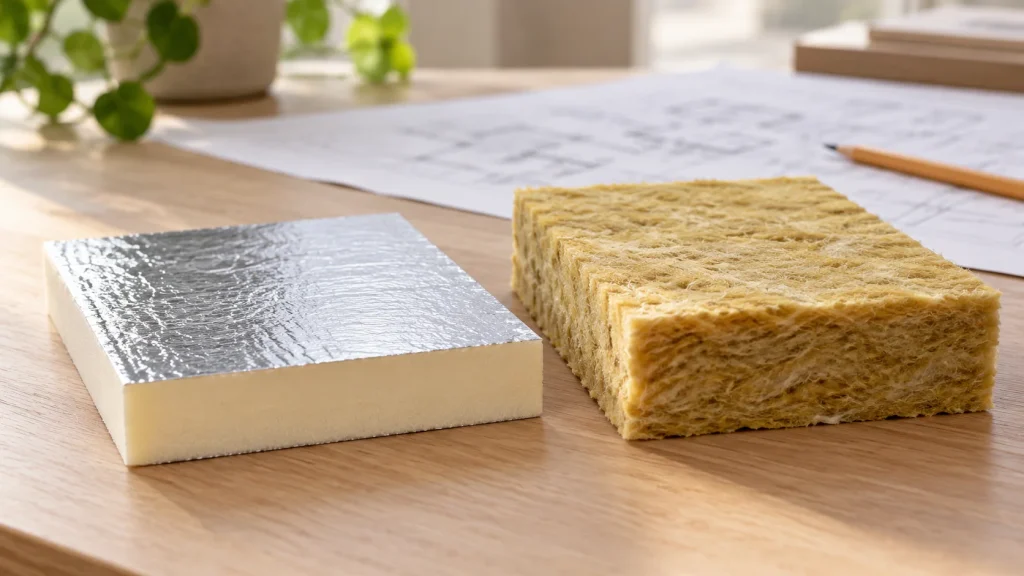
Swapping insulation is a familiar decision on a building project. A product is unavailable, a different board costs less, or you need a thinner build-up. You check the U-value and carry on.
But what happens where that wall meets the floor or roof? If the specification changes, the Psi-value used for that junction may need checking too.
A Psi-value belongs to a detail
A U-value describes heat transfer through a wall, floor or roof. A Psi-value accounts for the additional heat transfer at a junction between elements, such as a wall meeting a ground floor.
The junction value depends on its geometry and materials. It is not a fixed number attached to the name ‘flat roof’ or ‘ground floor’. Two details with the same name can perform differently.
That is why a published Psi-value comes with a drawing, material specifications and conditions for its use. The number needs to match what you are building, within any permitted variations.
What changes when you change the insulation?
Three things are worth checking:
- Thickness: a different insulation thickness can change the geometry and how the insulation meets the adjoining element.
- Conductivity: materials with different thermal conductivities allow different amounts of heat to pass through them. The same thickness does not necessarily give the same performance.
- Position: moving the insulation can change its continuity through the junction, even where the finished wall or roof achieves a similar U-value.
A better U-value does not automatically mean a lower Psi-value. They describe different parts of the heat loss calculation, and the junction needs to be considered on its own terms.
Think about a flat roof and parapet
Imagine a roof detail with insulation above the deck, meeting the wall insulation at a parapet. A revised specification changes the roof insulation and the upstand arrangement.
The roof may still achieve its target U-value. But the path for heat through the roof edge has changed. An existing Psi-value cannot be assumed to describe the revised detail.
This does not mean the new design is worse. It means you need to check whether the evidence still covers it.
Does every change need another calculation?
No. Some published details cover a range of insulation thicknesses, conductivities or other specifications. Start by checking those limits and the critical features of the detail. A change within the stated scope may already be covered.
If it falls outside that scope, ask your assessor or the detail provider to confirm the next step. You might use another applicable detail, adjust the design or commission a bespoke calculation.
BRE’s BR 497 conventions explain the calculation framework for linear thermal transmittance and temperature factors.
Check before the revised detail is built
Keep the original detail reference alongside the revised drawing, insulation product, thickness and conductivity. Flag the change to your assessor while there is still time to resolve it.
If you need a bespoke thermal bridging calculation, send us the original and proposed details. We can review the junction and confirm a fixed price for modelling the revised construction.